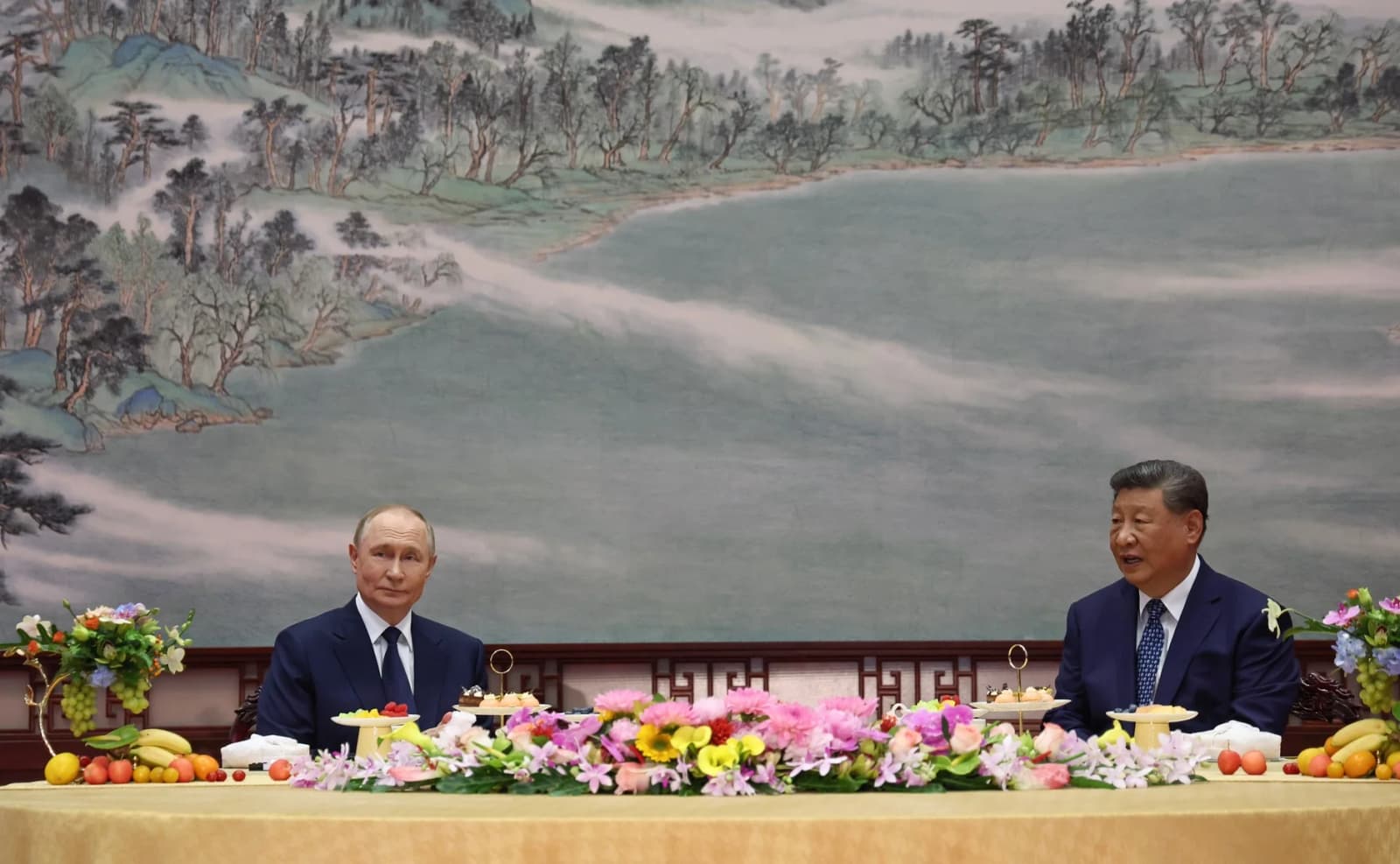
Chinese President Xi Jinping and Russian President Vladimir Putin held talks in the southern Chinese city of Shenzhen on Wednesday, 18 November 2026, a day before both are due to sit down with US President Donald Trump in the first three-way summit of the three leaders. The meeting, on the sidelines of the Asia-Pacific Economic Cooperation (APEC) summit, has drawn wide coverage because of what is on the table: nuclear weapons, the Iran war, trade and, possibly, Ukraine.
What happened on Wednesday
Xi and Putin began talks around midday, Chinese and Russian news agencies reported, according to Euronews, which carried AFP and AP material. It was the leaders' fifth meeting this year, one of them by video link. Chinese state media quoted Xi as describing the relationship as "stable as a mountain, unshaken by storms", according to a BBC report cited by the news aggregator Newscord.
Beijing said only that the leaders would hold "in-depth exchanges on safeguarding world peace and promoting strategic stability in major-power relations." According to AFP, as published by Kyiv Post, the Russian side said the two would first discuss energy and finance and then turn to foreign policy, including Ukraine and North Korea.
Addressing the APEC gathering, Putin said he expected the trilateral meeting to be "highly useful" and argued that with military and political risks rising, "what is desperately needed is unity rather than division... and dialogue rather than ultimatums." He also said Western sanctions had failed to halt growth in targeted economies, Euronews reported. Anadolu Agency reported that Putin called economic coercion a "thing of the past". Xi, opening the forum, called for stronger cooperation on artificial intelligence and free trade and said China would pursue "deep-seated reform", starting with lower tariffs and wider market access.
How the summit came together: a timeline
- February 2026: The New START treaty, the last nuclear arms control pact between Washington and Moscow, lapsed. Trump rejected a Russian offer to extend it by a year and called instead for a "new, improved and modernised" deal that includes China, Al Jazeera reported.
- Around October 2026: Putin proposed a three-way meeting to help end the war in Ukraine, according to The Wall Street Journal, as cited by CNBC.
- 14 November: The White House said the three leaders would meet on the sidelines of APEC in Shenzhen, Al Jazeera reported.
- 16 November: China's foreign ministry confirmed the meeting after Moscow and Washington had announced it. Spokesperson Mao Ning described it as having "groundbreaking significance", The Hans India reported.
- 17 November: In Manila, Trump attended the first leader-level meeting of the Quad in more than two years, alongside Prime Minister Narendra Modi, Australian Prime Minister Anthony Albanese and Japanese Prime Minister Sanae Takaichi, Anadolu reported.
- 18 November: Xi and Putin met in Shenzhen.
- 19 November (Thursday): The trilateral summit is scheduled.
The numbers behind the talks
- With New START gone, the United States and Russia have no caps on their nuclear arsenals for the first time in more than 50 years, Al Jazeera reported.
- According to the Stockholm International Peace Research Institute, Russia holds the most nuclear warheads, followed by the US and then China, Al Jazeera said. Pentagon estimates cited by AP put China at more than 600 warheads, against more than 5,000 each for the US and Russia, according to The Hans India.
- Xi has met Putin more than 40 times since becoming president in 2013, CNBC reported.
- A US-China trade truce expires in January, CNBC said; analysts largely expect it to be extended.
What each side wants
The White House has said Trump wants to talk about reducing nuclear weapons and the US-Israeli war with Iran. White House spokeswoman Olivia Wales said Trump considers the spread of nuclear weapons very dangerous, CNBC reported. A senior administration official told Reuters, as reported by Al Jazeera: "We do not expect to get to any kind of agreement," describing the meeting as the start of a conversation.
China has long argued that the US and Russia must cut their far larger arsenals before it discusses limits on its own, Euronews noted. Russia wants Ukraine high on the agenda: presidential aide Yuri Ushakov said the talks would continue efforts toward a settlement, CNBC reported.
Kremlin spokesman Dmitry Peskov called the meeting "extremely significant" but rejected comparisons with the 1945 Yalta conference, saying agreements reached in Shenzhen cannot be imposed on others, according to Al Jazeera.
Other perspectives
Ukrainian President Volodymyr Zelenskyy has voiced concern that the summit could become a forum to discuss a Ukraine deal without Kyiv, Al Jazeera reported. A European diplomat told CNN the optics were "of course awful for us", and a European official called the meeting a "Putin dream", Newscord's summary of CNN's coverage said.
Analysts quoted by CNBC were sceptical. David Roche of Quantum Strategy called it an "almost 100% photo op" that would lift China's standing, while Neo Wang of Evercore ISI said the main obstacle was "a disagreement over the agenda" and that a joint statement on Ukraine, security or sanctions was unlikely. Han Lin of the Asia Group told NBC News that "all three are seeking something different." UN Secretary-General Antonio Guterres said the UN was ready to support any denuclearisation initiative that emerges, The Hans India reported.
The India context
The Shenzhen meetings come a day after the Quad leaders' meeting in Manila that Prime Minister Narendra Modi attended, where Trump called the four countries "the four corners of a free, open, stable and prosperous Indo-Pacific", according to Anadolu. Euronews noted that the Quad is broadly seen as a counterweight to Chinese influence.
The Iran war, one of the White House's stated priorities for the summit, is linked to shipping in the Strait of Hormuz. Anadolu reported that US-Iran talks remain stalled over navigation in the strait.
On trade, the US-China truce is due to expire in January, and AFP, as carried by Kyiv Post, reported new US licence requirements for advanced AI chip shipments to Singapore, Malaysia, Thailand and Indonesia.
What is established
- Xi and Putin met in Shenzhen on 18 November; both Chinese and Russian news agencies reported the talks.
- The three-way meeting is scheduled for Thursday, 19 November, in Shenzhen; it has been confirmed by the White House, the Kremlin and China's foreign ministry.
- The New START treaty lapsed in February 2026, leaving no caps on US and Russian arsenals.
- The White House has listed nuclear weapons and the Iran war as Trump's priorities.
What is uncertain
- Ukraine's place on the agenda: Washington initially signalled Ukraine would not be discussed, but Trump later said it would be, Euronews reported. Moscow wants it prominent; Beijing has not said.
- A Trump-Kim meeting: Trump said he hoped to meet North Korean leader Kim Jong Un in Shenzhen and that Kim "would like" to meet. Secretary of State Marco Rubio did not confirm it, China said it had "no information", and Al Jazeera had earlier reported that no such meeting was expected.
- Any concrete outcome: US officials expect no agreement, and analysts doubt a joint statement. Whether China will join any arms control process is unresolved.
What next
The trilateral takes place on Thursday at APEC in Shenzhen. Beyond it, the next markers are the January expiry of the US-China trade truce and the US-led Ukraine negotiations that European governments have agreed to join, with US envoys expected in Berlin on Thursday, according to a news digest citing Bloomberg and Politico Europe.