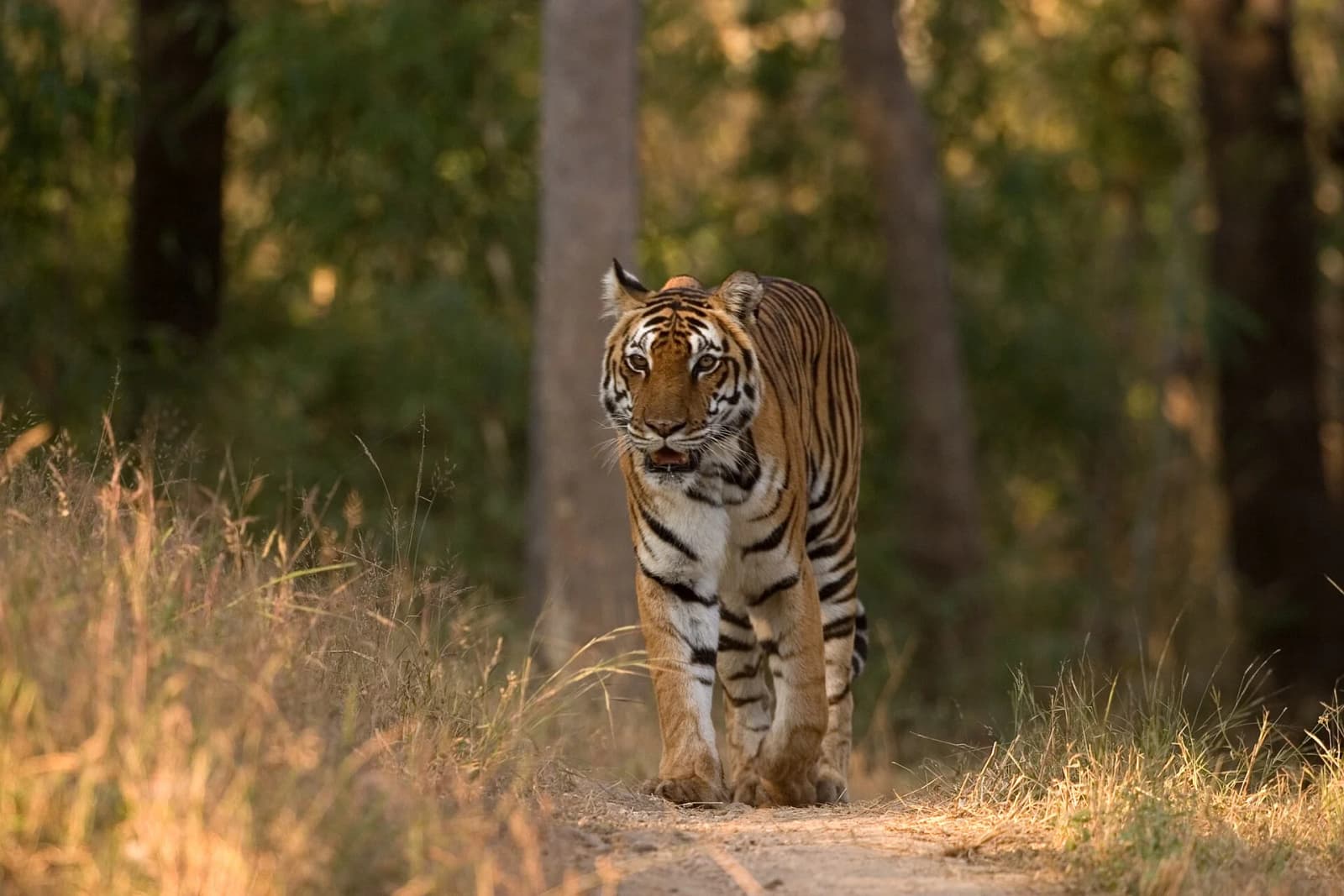
The Madhya Pradesh High Court will hear a public interest litigation (PIL) on tiger deaths in Kanha Tiger Reserve, Mandla district, again on 30 November 2026, after a Division Bench at Jabalpur on 19 November 2026 ordered the reserve's director to appear in person because the state's report on the deaths was incomplete. At the centre of the case is canine distemper virus (CDV), a disease best known in dogs. Here is what it is, why it matters for tigers, and what is known and unknown so far.
What is canine distemper virus?
Canine distemper virus is a highly contagious viral disease of carnivores that attacks the respiratory, gastrointestinal and central nervous systems of dogs and wild carnivores, according to a description in ETV Bharat's report of the case. It spreads through airborne droplets from coughing or sneezing, contact with infected body fluids such as saliva, urine and eye or nasal discharge, and shared drinking water, the report said.
Neurological signs listed in the same report include muscle twitching, head tilting, circling and seizures. Lawyers for the petitioner told the court that CDV can make tigers lose their aggression and hunting instincts, according to ETV Bharat.
Why is it in the news?
It is in the news because the High Court has found the state's account of the Kanha deaths inadequate. As MapMyTimes reported, a Bench of Chief Justice Alpesh Y. Kogje and Justice Vivek Jain said on 19 November that the report filed by the Director of Kanha Tiger Reserve lacked the details sought in its order of 26 October, and summoned him to appear on 30 November. The Advocate General of Madhya Pradesh has also been asked to be present, Hindi outlets reported.
What is the case about?
The PIL, Subit Chakraborty v. Union of India, was filed by a Mumbai-based advocate and argues that tiger deaths in Kanha point to failures in disease surveillance and monitoring under the National Tiger Conservation Authority (NTCA) framework, LiveLaw reported in July 2026. The petition names tigress T-141 and her four cubs, tigress T-122 and tiger T-220, and says eight tigers died in April and May 2026, according to reports by LiveLaw and ETV Bharat.
How has the case moved so far?
- 10 July 2026: A Bench of Justice Anand Pathak and Justice B.P. Singh asked the state to keep vigilance over all tiger reserves and said CDV vaccination should be provided "whenever and wherever" required, LiveLaw reported. The petition covers all nine tiger reserves in the state.
- 26 October 2026: The court sought a detailed report from the state and the Forest Department on two more tiger deaths in Kanha in September and October, a status report on dog vaccination and funding for CDV prevention in other reserves, and a report from the Centre on reduced funding, ETV Bharat reported.
- 19 November 2026: The Bench found the Kanha director's report deficient and summoned him for 30 November.
Why are dogs part of the story?
Dogs matter because domestic and stray dogs living around reserves can carry the virus. The petition asked the central and state governments to quarantine and vaccinate dogs to stop CDV spreading, ETV Bharat reported, and the court has earlier ordered vaccination of dogs in areas where tigers move, according to LiveLaw.
Scientific research suggests dogs are not always the whole picture. A 2020 study in the Proceedings of the National Academy of Sciences, led by the Cornell Wildlife Health Center, the University of Glasgow and the Wildlife Conservation Society, found that other wild carnivores, rather than domestic dogs, were the main source of CDV for Amur tigers in the Russian Far East, the University of Glasgow said. The researchers concluded that vaccinating local dogs alone would not protect tigers there, and their model found that vaccinating two tigers a year in a small population could cut the extinction risk from CDV by almost 75%, at a cost of about US$30,000 a year or less if done during routine radio-collaring. They also noted that no oral CDV vaccine exists that could be spread through bait to wild carnivores. That study was about Russia, not central India, and its findings cannot simply be transferred to Kanha.
What is established, and what is not?
Established: the High Court is monitoring the case; it has called the state's latest report incomplete; the Kanha director must appear on 30 November; and the petition links a series of deaths in 2026 to CDV.
Not established: how many tigers actually died of CDV. Petitioner's lawyers told the court that around 20 tigers had died in Kanha in six months and that post-mortem reports of five indicated CDV, ETV Bharat reported, but these figures come from one side of the case. Official post-mortem findings have not been made public, and the state has not issued a detailed public account.
How does it affect you?
For most readers the direct effect is limited, but for people living in villages around Kanha and other reserves, the court's orders mean continued attention to dog vaccination and disease monitoring near tiger habitats. For visitors and the wider public, the case is a test of how openly the state reports wildlife deaths in one of Madhya Pradesh's best-known reserves. The petitioner has also raised funding, telling the court that central funding for the state's tiger reserves was cut to one-quarter this year, ETV Bharat reported; the government's response to that claim is awaited.
What happens next?
The High Court will hear the matter on 30 November 2026, when the Kanha director is due to explain the gaps in his report and the state is expected to give a fuller account of the deaths. The Kanha management had not publicly commented on the 19 November order at the time of writing.
Photo source · Kalyan Varma, CC BY-SA 3.0