Union Minister Jitendra Singh called for clearer explanations of publicly funded science on November 10 while chairing the second general body meeting of the Earth System Sciences Council. The review brought weather forecasts, marine advisories and deep-ocean exploration into the same discussion about how research reaches citizens.
According to the Ministry of Earth Sciences, Singh urged scientific institutions to combine research expertise with professional communication, coordinate their outreach teams and engage regularly with journalists. The emphasis was on explaining the practical relevance of scientific work in language accessible beyond laboratories.
The council examined annual reports and audited accounts for 2025–26 from five institutions: the National Institute of Ocean Technology, Indian National Centre for Ocean Information Services, National Centre for Earth Science Studies, Indian Institute of Tropical Meteorology and National Centre for Polar and Ocean Research.
Ocean exploration and public services
The Deep Ocean Mission review included development of MATSYA-6000, a human submersible designed for depths of 6,000 metres. The ministry separately reported that Indian aquanauts had completed dives to 4,025 metres and 5,002 metres aboard the French submersible Nautile. Those dives should not be confused with a completed 6,000-metre MATSYA mission.
Pragativadi’s report on the meeting also described updates on desalination technology for Lakshadweep, offshore fish cages, oceanographic instruments and ocean thermal energy conversion. These were areas of progress presented to the council, rather than an announcement that every technology had entered commercial service.
Weather-related discussions covered Mission Mausam, the PRITHVI programme and forecasting systems. Ocean services included multilingual information for fishing communities and forecasts of coastal inundation associated with swell surges. Such services connect the institutions’ research to decisions made by people working at sea or living along the coast.
Polar research and the next proposal
The polar review covered the 45th Indian Antarctic Expedition, involving 95 members, the 16th Arctic Expedition and Himalayan glacier monitoring. Earth-science work also included landslides, tectonic processes and rainfall over the Western Ghats.
Singh proposed a mission-mode approach for polar and solid-earth sciences. That proposal is distinct from a newly approved programme: the meeting account does not specify a sanctioned budget or implementation timetable for it.
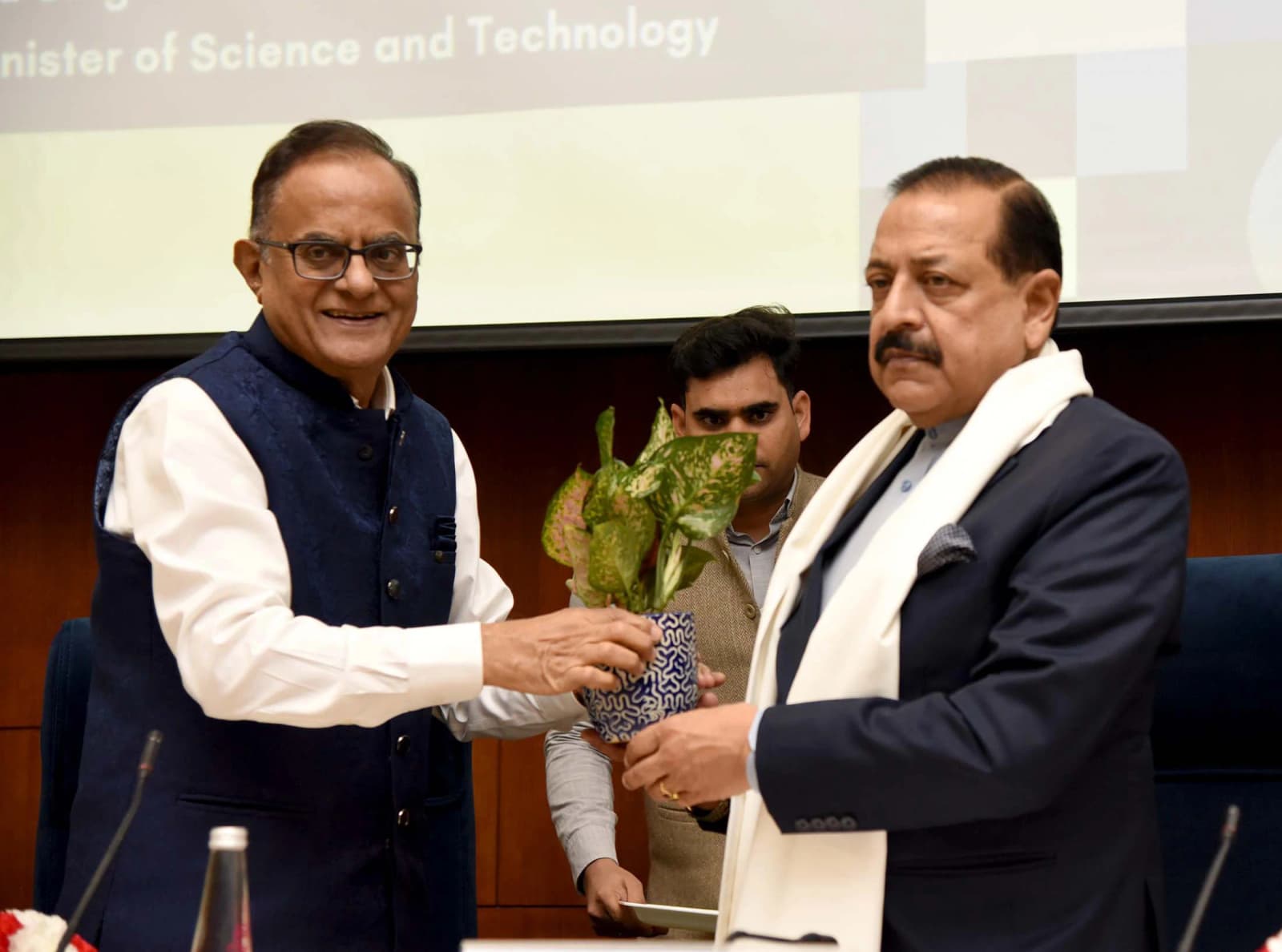
Archive photograph: Jitendra Singh (right) with Ajay Kumar Sood at a science report launch in New Delhi, March 14, 2024; not the November 2026 ESSC meeting. Photo: NKP / Photo Division, PIB; Office of Principal Scientific Advisor to GoI, Government of India · PS · Government Open Data License–India. Converted to WebP for publication; original frame retained.