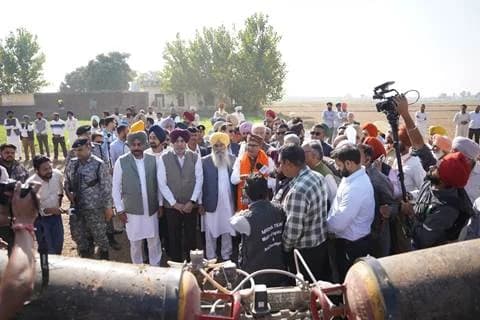
The Centre on 17 November approved more than ₹350 crore for agriculture in Punjab, with Union Agriculture Minister Shivraj Singh Chouhan handing over the approval letters to the state's Agriculture Minister Gurmeet Singh Khuddian at a farmers' programme in Mohali district, the Ministry of Agriculture and Farmers Welfare said.
According to the ministry, the package has two parts: ₹254.20 crore released as the second tranche under the Pradhan Mantri Rashtriya Krishi Vikas Yojana (PM-RKVY) for the financial year 2026-27, and seven new projects worth ₹98.44 crore approved under the state's Annual Action Plan. The ministry said the seven projects were cleared at the request of the Punjab government.
Chouhan was speaking at a 'Khet Bachao Abhiyan' programme at Badarpur village in Sahibzada Ajit Singh Nagar (Mohali) district. The ministry said the nationwide campaign is being run from 22 October to 30 November 2026 on the theme 'Healthy Soil, Prosperous Farmers'.
'Serving farmers is a shared responsibility'
The ministry said Chouhan told the gathering that the central and state governments may be run by different parties, but that should make no difference to their shared responsibility towards farmers. Later in the day, at Krishi Vigyan Kendra, Samrala, in Ludhiana district, he said agriculture is a state subject but there should be no politics between the Centre and the state in serving farmers, and that the Centre had approved all the proposals submitted by Punjab's Agriculture Minister under the scheme, according to a second ministry statement.
Warning on fertiliser 'tagging', new pesticide law planned
Chouhan said no dealer or shopkeeper would be allowed to force farmers to buy other products along with fertiliser, a practice known as tagging. "If anyone engages in black marketing or tagging, the only place for them will be jail," the ministry quoted him as saying.
He also said the government is preparing to replace the existing pesticide law with a stricter one to deal with fake fertilisers, spurious seeds and substandard pesticides, and that suggestions are being sought from farmers and experts. At Samrala he said a new seed law is also being prepared, the ministry said. No timeline for either law was given in the statements.
On subsidies, the minister said the Centre supplies a bag of DAP to farmers at ₹1,350 against a cost of about ₹5,000, and a bag of urea costing around ₹3,000 at ₹266. To stop subsidised fertiliser being diverted to industrial or other unauthorised use, the government is issuing 'Farmer IDs', and six lakh such IDs have been created in Punjab so far, he said.
Green ammonia trial on 10,000 hectares
At Badarpur, Chouhan watched a live demonstration of green ammonia and said it is being tried for the first time across 10,000 hectares as an alternative to urea, the ministry said. Akashvani News reported that 1,008 hectares of this area is in Punjab.
The minister urged farmers to get their soil tested before applying fertiliser, saying indiscriminate use of urea, DAP and other chemical fertilisers was making the soil sick.
Transport cost for potato, onion and tomato
At Samrala, Chouhan outlined two price-support measures, according to the ministry:
- If prices of potato, onion or tomato fall in Punjab while better prices are available in cities such as Delhi, Mumbai, Kolkata or Chennai, the Centre will bear the entire cost of transporting the produce to those markets for sale through state government agencies.
- Under the Market Intervention Scheme, if farmers are forced to sell at very low prices, the Centre and the state will share the cost equally, and the price difference will be transferred directly to farmers' bank accounts.
Stubble, small farms and machinery
On stubble burning, Chouhan said farmers should not be blamed every time pollution is discussed. He described stubble as food for the soil that raises its organic carbon, and said the government would work to make stubble-management machines such as seeders more affordable. At Mohali, he assured farmers of an 80 per cent subsidy on farm machinery for small groups and of positive action on the Morinda Sugar Mill and on stray cattle, the ministry said.
He also praised a three-crop model developed by Punjab Agricultural University, under which, he said, a farmer can grow three crops on one acre and earn a net income of up to ₹1.5 lakh a year, and asked KVK Samrala to popularise it. He urged farmers to move beyond the wheat-paddy cycle and to try natural farming on part of their land.
PS · Press Information Bureau, Government of India