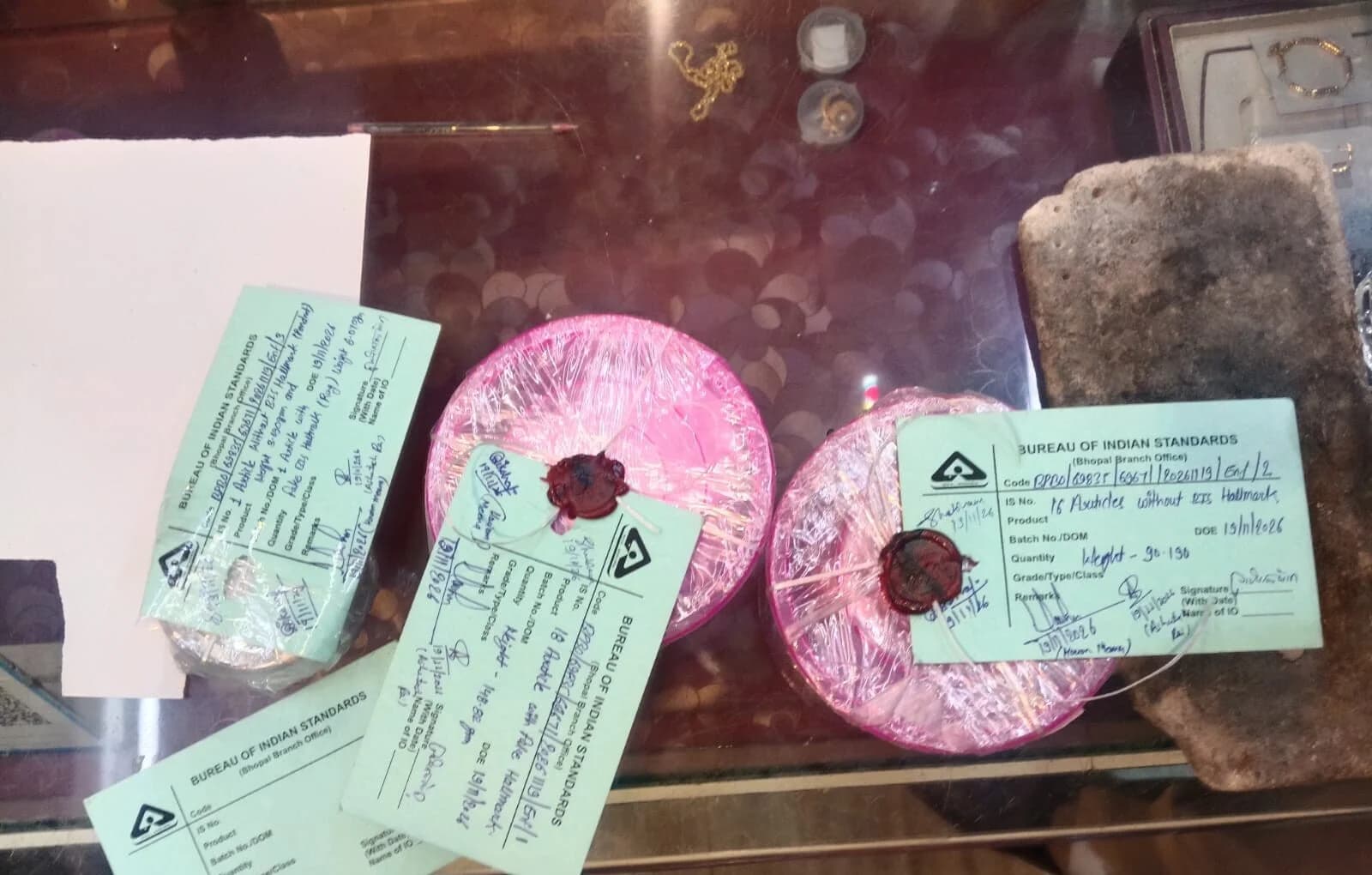
Officials of the Bureau of Indian Standards (BIS) from its Bhopal branch seized 36 pieces of gold jewellery, 19 of them carrying fake hallmarks, in a search and seizure operation at a jewellery shop in Sagar, Madhya Pradesh, on 19 November 2026.
The raid was carried out at M/s Ganpati Jewellers on Kotwali Road in Rampura Ward (Ward No. 29) of Sagar city, according to a release issued through the Press Information Bureau (PIB) in Bhopal. Apart from the 19 items with allegedly fake hallmarks, 17 items were being kept without any hallmark at all.
What was seized?
BIS put the total weight of the seized jewellery at about 248.77 grams. The release breaks it down as follows:
- 18 mixed jewellery articles with fake hallmarks, weighing about 148.82 grams;
- 16 mixed jewellery articles without hallmarks, weighing about 90.19 grams;
- one ring with a fake hallmark (about 6.07 grams) and one pendant without a hallmark (about 3.69 grams).
The articles were sealed according to the prescribed procedure, BIS said, and legal proceedings will be started under the Bureau of Indian Standards Act, 2016. The jeweller has not publicly responded, and the allegations have not yet been tested in any proceeding.
Why is selling unhallmarked gold an offence?
Selling gold jewellery without a valid BIS hallmark is not allowed in districts that fall under mandatory hallmarking, and Sagar is one of them, BIS deputy directors Hariom Meena and Ashutosh Rai said. They said both putting a fake hallmark on jewellery and selling unhallmarked jewellery in such districts violate the law, and that the BIS Act provides for penal action.
A hallmark is meant to certify the purity of the gold a buyer is paying for. A fake mark means a customer has no reliable assurance that, for example, a piece sold as 22-carat actually is.
How can you check whether your jewellery is genuine?
Buyers can check a piece by entering its Hallmark Unique Identification (HUID) number in the BIS Care app. BIS asked consumers to verify the HUID before buying and to insist on a proper purchase invoice. According to the BIS hallmarking FAQ, the app's "Verify HUID" feature also shows the registration number of the jeweller who sold the article, so a buyer can match the two.
The same FAQ says that if a hallmarked article is found to be of lower purity than marked, the buyer is entitled to compensation from the jeweller of twice the shortfall in value for the article's weight, plus testing charges.
Where can complaints be made?
Consumers who doubt a hallmark or the quality of a product can lodge a complaint on the BIS website, bis.gov.in, or through the BIS Care app, the bureau said. Its FAQ also lists complaints@bis.gov.in as a contact.
What happens next?
BIS will now pursue legal action against the shop under the BIS Act. It has not said when the case will be filed or what penalty it will seek.
Photo source · Bureau of Indian Standards / PIB Bhopal handout