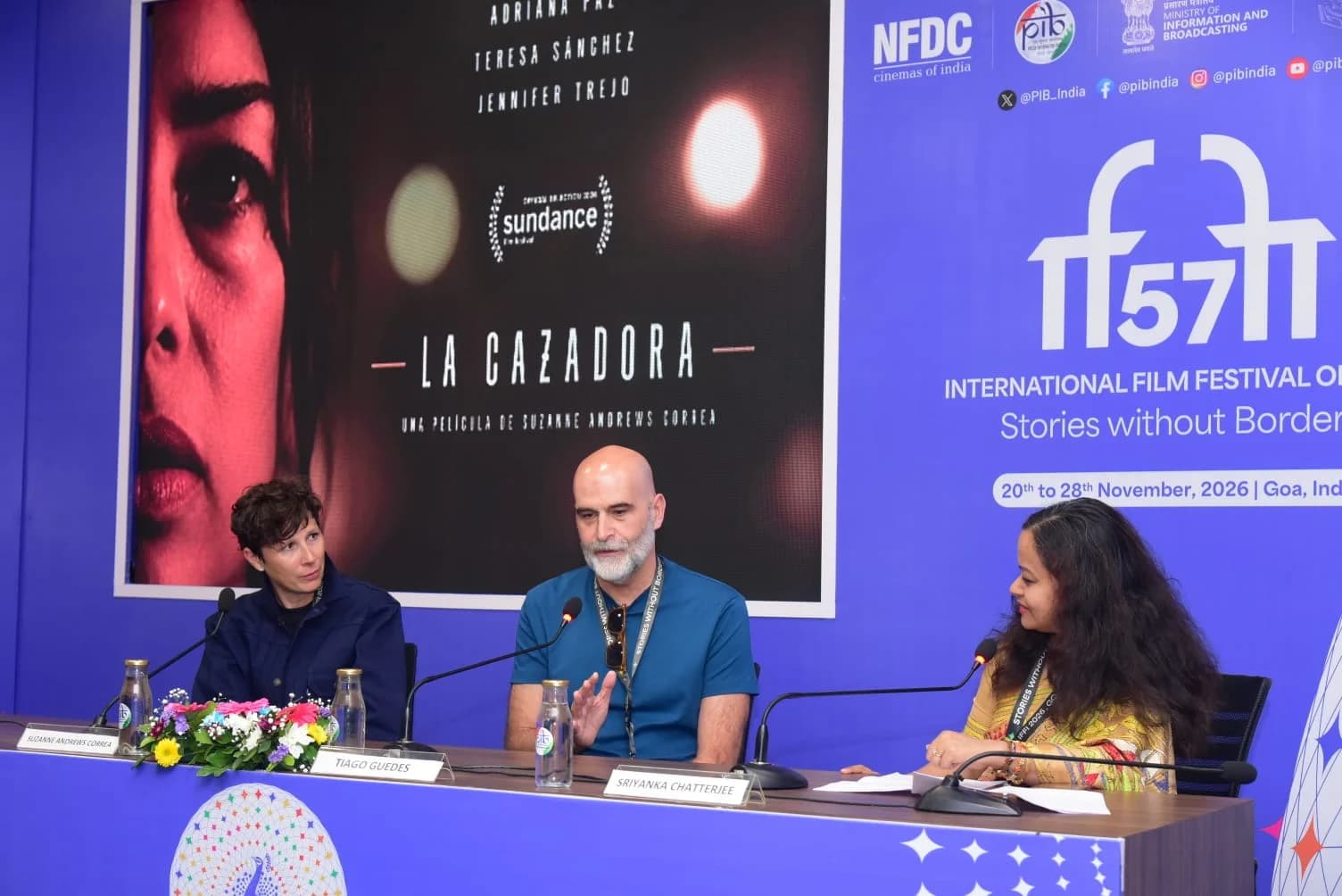
Directors Tiago Guedes and Mexican-American filmmaker Suzanne Andrews Correa told reporters at the 57th International Film Festival of India (IFFI) in Goa on 23 November 2026 that they want audiences to feel their films before they understand them. Guedes's Aquí is in the International Competition. Correa's debut feature is The Huntress (La Cazadora).
The session was moderated by Sriyanka Chatterjee, according to a Press Information Bureau (PIB) release.
What is 'Aquí' about?
Aquí is a dystopian drama that turns J. M. Coetzee's three Jesus novels into one film. It premiered at the Cannes Film Festival on 18 May 2026. In the film's world, people start life with no memory of their past, and the society enforces conformity. A man named Simón takes in David, a boy he met on the journey there. Believing the boy needs a mother, Simón finds Inés, and the three form an unusual family. David does not fit in, and his imagination and wish for freedom test the rules around him.
Guedes said he paid more attention to the feelings the books gave him than to their plot. He said this helped bring the intensity of Coetzee's writing to the screen. In his film, family is something people choose, not something set by blood, and he said he wanted to explore this without turning to religion. The title means "Here" in Spanish and Portuguese.
He said the camera moves from wide shots to closer ones as the characters make their choices, bringing viewers nearer to them. He also leaves silences and some ambiguity so audiences can reach their own readings. Aquí is due for release in Portugal, Spain and France in January.
A vigilante story from Ciudad Juárez
The Huntress is a Spanish-language drama thriller written and directed by Correa. Adriana Paz plays a factory worker and assault survivor in Ciudad Juárez, on the Mexico-Texas border, who turns to vigilante justice. The film draws on real violence against women there. It also draws on a 2013 case in which an unidentified woman known as "Diana, Hunter of the Bus Drivers" shot and killed bus drivers at a time of widespread impunity. The story takes place over 24 hours.
Correa said she wanted viewers to feel the character's powerlessness and desperation. That way, they could understand why she took matters into her own hands when her calls for help went unanswered. She said the film is also a call for justice and an end to crimes against women.
The film took her ten years to make, alongside other projects. She said the experience taught her to "stay with the story" and to communicate well with crew, actors and audiences. She said she had worried that viewers abroad might not connect with the story without knowing the real events behind it. She described herself as both saddened and humbled to see its fear and emotion reach audiences in different countries.
Why it matters
The festival runs until 28 November under the theme "Stories Without Borders". PIB said the two films show how stories rooted in a specific place can still reach audiences across languages. This week, the directors of 'Rahma' and 'The Farm' also spoke at the festival.
Photo source · PIB