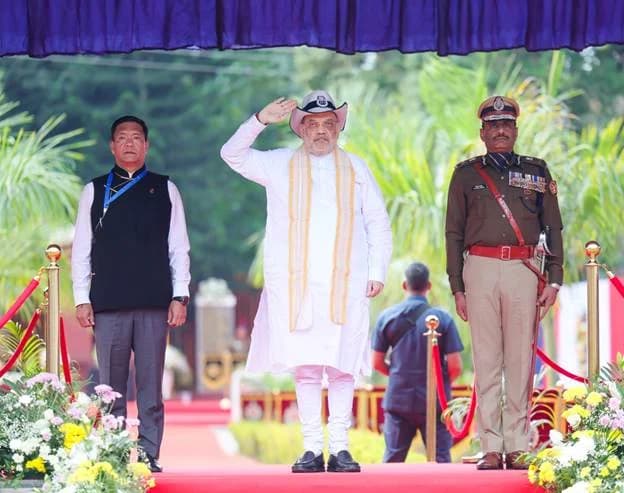
Union Home Minister Amit Shah on 21 November 2026 presented the President's Colour to the Arunachal Pradesh Police at a ceremony in Itanagar, making it the 17th police force in India to receive the honour, according to a Ministry of Home Affairs release issued through the Press Information Bureau.
Chief Minister Pema Khandu, Union Minister Kiren Rijiju, Union Home Secretary Govind Mohan, Intelligence Bureau Director Mahesh Dixit, Chief Secretary Manish Gupta and Director General of Police Rajesh Kumar were among those present, the release said.
What is the President's Colour?
The President's Colour is a ceremonial honour given to a police force in recognition of more than 15 years of service marked by courage, dedication and sacrifice, Mr Shah said at the event. He described it as a moment that comes only once in the lifetime of a state.
He traced the force's history to 1971, when the region was still the North-East Frontier Agency (NEFA) and security had been handled by the Assam Rifles. The force was set up that year under senior police officer L.B. Sewa, who, Mr Shah said, was killed in 1974 while fighting armed militants in Mizoram.
According to the minister, the force now has more than 16,000 personnel spread across four ranges and 29 police districts, with two battalions of the Arunachal Armed Police and five India Reserve Battalions.
Why does Arunachal Pradesh's border matter for policing?
Mr Shah said the state's international border runs 1,863 km, including 1,226 km with China, 520 km with Myanmar and 217 km with Bhutan, which makes its security important for the whole country. He said the state also lies on a route used to smuggle narcotics into India, and asked the police to ensure that not a single gram of drugs enters the country through Arunachal Pradesh.
He listed insurgency, organised crime, drug trafficking and cybercrime as the main internal security tasks before the force.
Claims on spending and new criminal laws
The minister said governments between 2004 and 2014 spent ₹33,530 crore on the North-Eastern region, while works worth ₹1,49,646 crore had been undertaken between 2014 and 2026. He said the annual railway budget for the region had risen from ₹2,100 crore in 2014 to ₹11,486 crore in 2026–27. These figures were presented in his speech and have not been independently checked.
Referring to India's new criminal laws, Mr Shah said every First Information Report (FIR) registered after 2027 would be decided within three years, including at the Supreme Court stage.
Message on the Siang project and Kashmir
Addressing residents of the Siang region about the proposed Siang Upper Multipurpose Project, Mr Shah said the government would move forward only through dialogue, take local people into confidence at every stage and offer what he called the most attractive rehabilitation package in India, without harming local traditions, culture or religion.
He also said police in Kashmir had recently killed the last known active local militant of the Lashkar-e-Taiba in an encounter in Pulwama, and claimed that no local militant now remains in the Kashmir Valley. The release did not give the date of that encounter.
What happens next?
Mr Shah is scheduled to attend a cooperative sector event at the Dorjee Khandu State Convention Centre in Itanagar on Sunday, 22 November, where he will launch state schemes with a combined outlay of ₹5,610.95 crore, according to a separate Ministry of Cooperation release. These include Mission Shikshit Arunachal Phase II (₹1,500 crore), state power and rural road development programmes (₹2,000 crore each) and 199 projects worth ₹110.95 crore under the Vibrant Villages Programme in 11 border districts. He is also due to release an "Arunachal Pradesh Cooperative Vision 2047" document.
Photo source · PIB, GODL-India