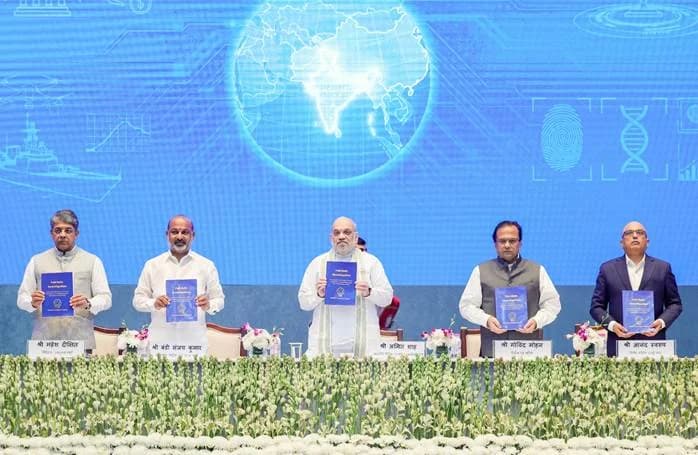
Union Home Minister Amit Shah on 19 November 2026 told a two-day counter-terrorism conference in New Delhi that the Centre wants a single, uniform anti-terror strategy to work down to the level of every police station in the country. Opening the meeting, he also released a National Investigation Agency (NIA) publication titled 'Fail-Safe Investigation', e-launched the agency's 'Pushti' portal and decorated seven NIA officers and personnel, according to a Ministry of Home Affairs release issued through the Press Information Bureau.
At the same event, Mr Shah laid the foundation stone for an NIA office complex in Chandigarh and inaugurated an NIA residential complex at Maidangarhi in Delhi.
Who attended the counter-terrorism conference?
The conference brought together senior police officers from states and Union Territories, officers of counter-terrorism agencies, and experts in law, forensics and technology, the release said. Minister of State for Home Affairs Bandi Sanjay Kumar, Union Home Secretary Govind Mohan, Intelligence Bureau Director Mahesh Dikshit, Special Secretary (Internal Security) Anand Swarup and NIA Director General Rakesh Aggarwal were among those present.
What did Amit Shah claim about Kashmir?
Mr Shah said that with the killing of Lashkar-e-Taiba militant Latif Bhat a day earlier, the whole of Kashmir was now free of India-born terrorists, a situation he said had come about after 35 years. MapMyTimes reported on 18 November on the Kulgam operation in which Bhat was killed. The claim about the absence of local militants is the government's own assessment; the release did not give figures for foreign militants still active in the region.
What numbers did the Home Minister give?
According to the release, Mr Shah said:
- The Shahzad Bhatti network has been declared a terrorist organisation under the Unlawful Activities (Prevention) Act (UAPA); more than 40 of its modules have been neutralised, over 100 cases registered and more than 271 people arrested.
- Since 2019, 303 fugitives have been brought back to India from 36 countries, with the Central Bureau of Investigation and the Home Ministry leading the effort.
- 70 new NIA special courts have been set up, and 16 new NIA branch offices and two zonal offices were approved.
- A 25-point integrated plan is being used to monitor and curb terror financing.
What changes did he list since 2019?
Mr Shah recalled that the NIA Act was amended on 2 August 2019 to bring new offences under the agency and widen its jurisdiction, and that the UAPA was amended on 14 August 2019 to let the NIA seize terrorists' property and to allow individuals to be designated as terrorists.
He added that the Multi-Agency Centre (MAC), the intelligence-sharing platform, was restructured in 2023 and its remit widened to cyber security, narcotics, organised crime and emerging radicalisation hotspots, and that a National Memory Bank had been set up to build a central database.
What did he ask states to do?
The Home Minister urged state police to study the approach used against the Shahzad Bhatti network, which he said aimed to arrest suspects before an attack could take place. He asked every state's Anti-Terrorism Squad (ATS) to strengthen its cyber expert unit, called for a system to pass police-station-level intelligence up to the Director General of Police so that actionable information can be extracted, and said investigations should not stop until an entire network is dismantled.
He also called for closer coordination with financial investigation agencies to hit "the entire chain of terror money", and said a four-cornered regional security grid in border states should be a key agenda item.
Why does it matter?
The conference is the Centre's main annual platform for aligning central agencies and state police on counter-terror work. Mr Shah's remarks signal what states are expected to prioritise. Separately, MapMyTimes reported on 18 November the NIA's arrest of an alleged Khalistan Zindabad Force supporter deported from the US.
What happens next?
The conference continues on 20 November in New Delhi. The release did not say whether its recommendations would be made public. Details of the new 'Pushti' portal and what it will be used for were not described in the release.
Photo source · PIB / Ministry of Home Affairs, PIB copyright policy