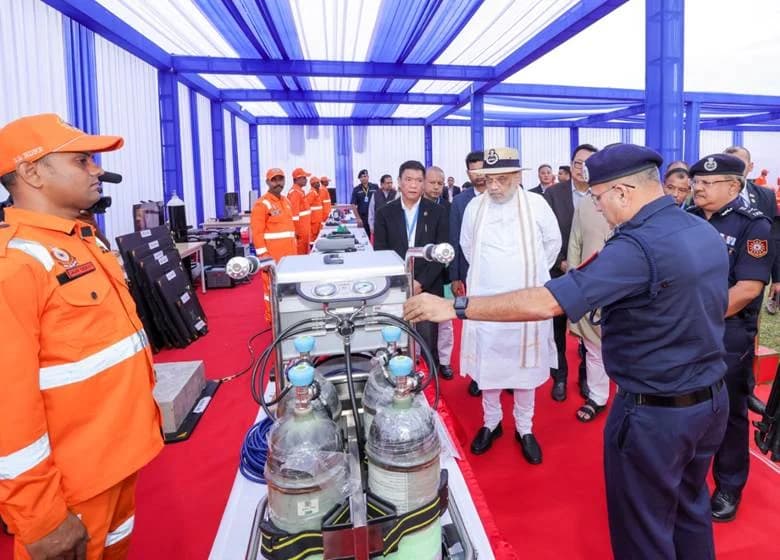
Union Home Minister Amit Shah on 22 November 2026 inaugurated the campus of the 12th Battalion of the National Disaster Response Force (NDRF) in Itanagar, the capital of Arunachal Pradesh, saying the facility would serve as a disaster response centre for the whole Northeast and some neighbouring regions, according to a Ministry of Home Affairs release issued through PIB.
Arunachal Pradesh Chief Minister Pema Khandu, Union Minister Kiren Rijiju, Deputy Chief Minister Chowna Mein, Union Home Secretary Govind Mohan, Intelligence Bureau Director Mahesh Dikshit and NDRF Director General Piyush Anand were among those present, the release said.
What will the new Itanagar campus do?
It will act as a base for responding to natural disasters across Arunachal Pradesh and the Northeast, and it will also train the State Disaster Response Forces (SDRFs) of all eight northeastern states, Shah said. He described Arunachal Pradesh and the wider Northeast as among the regions most exposed to natural disasters and said every building on the campus had been built to earthquake-resistant standards.
The campus includes an Olympic-size swimming pool and a diving tank for training personnel. Shah said the pool would be opened free of charge to swimmers from Itanagar and the rest of Arunachal Pradesh, adding that he hoped a future Olympic medal from the region could begin there.
Numbers the minister cited
- The NDRF has carried out more than 11,000 operations and saved over 1.61 lakh lives so far.
- The force is now deployed at more than 70 locations across the country.
- Cyclone warnings that once came 24 to 48 hours ahead can now be issued up to seven days in advance.
- The Home Ministry met its goal of planting and nurturing more than 8 crore trees between 2019 and 2026, with CAPFs and the NDRF taking part.
Shah also said 2026 has been declared the Year of Capacity Building for the NDRF, and that the ministry had focused on three areas for the force: expansion, resources including modern equipment, and training.
From relief to preparedness
In his speech, Shah argued that India's approach to disasters had earlier been mainly reactive, with governments arriving after the damage was done. He said the country had since moved towards early warning, prevention, mitigation, preparedness, risk reduction and what he called a "Zero Casualty" approach, with NDRF and SDRF teams moving in as soon as an alert is received and people and livestock evacuated in advance.
He said the National Disaster Management Authority had prepared response protocols and standard operating procedures for different kinds of disasters and shared them with the states, and that the system now involves everyone from patwaris and NCC cadets to Scouts and Aapda Mitra volunteers. According to the minister, several cyclones in recent years passed without a single death because of advance preparation. These figures and claims are the government's own; the release did not list the specific cyclones.
Shah also pointed to NDRF deployments abroad, naming Japan, Nepal, Türkiye and Sri Lanka, and said he expected the force to become a leading disaster response agency worldwide.
Why it matters for the Northeast
The region shares borders with several countries and frequently faces earthquakes, floods and landslides. A permanent battalion base near Itanagar puts trained responders and an SDRF training hub closer to areas that can be cut off when roads fail. Shah said the Centre would support round-the-clock disaster relief operations across the Northeast throughout the year.
Part of a two-day Arunachal visit
The inauguration came on the second day of Shah's visit to the state. On the same day in Itanagar he unveiled the 'Arunachal Pradesh Cooperative Vision 2047' at a cooperative festival and launched development projects worth ₹5,610.95 crore, according to a separate PIB release. On Saturday he had reviewed security, border issues and development in the state.
Photo source · Press Information Bureau (PIB)